Writing a first sentence that pulls readers into your paper comes down to one job: giving the reader a reason to keep going and pointing toward the argument that follows. That holds whether you are drafting alone or the deadline has you thinking "write my paper" at midnight. A strong opening line is specific, connected to your thesis and free of filler, and it can be a question, a surprising fact, a short scene or a clear claim.
Most students lose more time on that single sentence than on any paragraph after it. The blank page makes every option look wrong, so the cursor blinks while the rest of the paper waits. The good news is that first lines follow patterns you can learn, and once you see how they connect to the paragraph behind them, the opening stops being the hardest part of the job.
How can I start my paper?
Start with the point your paper makes, then write the opening line that leads a reader toward it.
Many students try to write the first sentence before they know what the paper argues, which is why it feels impossible. Draft a working thesis first, even a rough one. It is also the moment many students start comparing their options, from asking a classmate to looking at an essay writing service USA students use for model papers, because the opening is where the paper feels most stuck.
With a working thesis in hand, the first sentence has a destination. Ask yourself what a reader needs to know or feel before that thesis makes sense. The answer might be a fact that shows the problem is real, a question that frames the debate, or a short example that makes an abstract idea concrete.
A practical order for drafting the start of a paper looks like this:
- Write a one sentence working thesis.
- List two or three facts, examples or questions that lead to it.
- Pick the one most likely to make a reader curious and turn it into your first sentence.
- Write the rest of the first paragraph, then return to the opening line once the body is drafted.
That last step matters. Your argument often sharpens while you write the body, and an opening drafted on day one may no longer fit the paper you finished. Revising the first sentence last is normal, not a sign that you started badly.
What kinds of opening lines work for a paper?
Most effective first sentences fall into a handful of types, and the right one depends on the subject and the assignment.
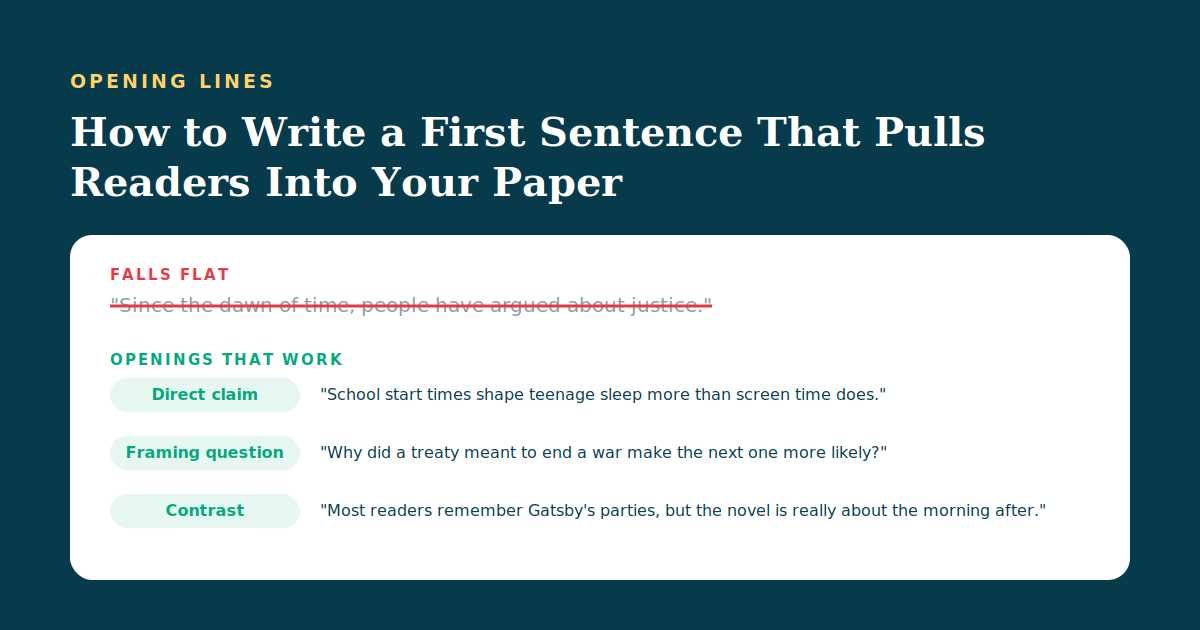
No single hook suits every paper. A personal scene can carry a reflective essay but would feel out of place in a lab report. The table below shows common types with sample lines written for different subjects, so you can see how each one sets up a different kind of argument.
| Opening type | Sample first sentence | Works well for |
|---|---|---|
| Direct claim | School start times shape teenage sleep more than screen time does. | Argumentative papers |
| Framing question | Why did a treaty meant to end a war make the next one more likely? | History and analysis |
| Concrete scene | The night before my first chemistry exam, I memorized formulas I did not understand. | Reflective and narrative essays |
| Contrast | Most readers remember Gatsby's parties, but the novel is really about the morning after. | Literary analysis |
| Verified fact | A fact from your own sources that shows the scale of the problem. | Research and policy papers |
Notice that every sample line hints at an argument. The sleep sentence already takes a side, and the Gatsby line promises a reading the paper will defend. A first sentence that only announces the topic, without any tension or direction, gives the reader nothing to follow.
Tone matters as much as type. A playful opening can undercut a paper about a serious public health issue, while a dry statement can flatten a personal narrative. Match the voice of the first sentence to the voice you plan to keep for the whole paper, so the reader is not surprised by a shift on page two.
If you use a fact, take it from the sources you will cite in the paper and cite it in the format your course requires. An unsourced statistic in the first line weakens trust in everything that follows, while a well sourced one shows the reader you have done the research.
How do I start my essay?
An essay opening can be more personal and voice driven than a formal paper, but it still has to point toward a clear thesis.
Shorter essays, such as personal statements, reflections and argumentative pieces, give you more freedom in the first line. A short scene or an honest admission can draw a reader in quickly. Formal papers in the sciences or social sciences usually prefer a direct statement of the problem, because the reader wants to know what is being studied before anything else.
The test is the same for both. Read your first sentence and the thesis together. If the jump between them feels abrupt, add a sentence or two of context in between. If the first sentence already says what the thesis says, move it later or replace it with something that sets the thesis up instead of repeating it.
A student who thinks "I should get my paper written so I have a reference" can still use this test. Reading how the opening of a model paper leads into its thesis shows the pattern more clearly than any list of rules, and it gives you a structure to apply when you write your own introduction.
Application essays add one more consideration. Admissions readers move through large stacks of statements, so an opening that drops them into a specific moment usually works better than a broad statement about your goals. Still, the scene has to connect to what the essay is about, or it reads as a trick rather than a beginning.
Which opening lines tend to fall flat?
Openings fall flat when they are so general, borrowed or decorative that they could begin almost any paper.
Instructors read many introductions, and a few patterns appear again and again. They are not wrong in any formal sense, but they use the most valuable sentence in the paper on something the reader already knows.
- The sweeping history: "Since the dawn of time, people have argued about justice." It is too broad to be true or useful.
- The dictionary entry: "Webster's defines courage as..." It borrows authority without adding insight.
- The announcement: "In this paper, I will discuss climate policy." It describes the paper instead of starting it.
- The empty question: "Have you ever wondered about social media?" A question only works when the answer is not obvious.
Some assignments, particularly in technical fields, do expect a plain statement of purpose, so check the brief and any examples your instructor shares. Outside those cases, swapping a generic line for a specific detail from your own research is usually the fastest improvement you can make.
A simple check helps here. Imagine your first sentence at the start of a classmate's paper on a different topic. If it would still fit, it is too general. A good opening belongs to your paper alone, because it carries a detail, a question or a claim that only your argument can follow up on.
How does the first sentence connect to the rest of the first paragraph?
The first sentence opens a short path that narrows from your hook to your thesis, usually over three to five sentences.
Think of the first paragraph as a funnel. The opening line catches attention, the next sentences give the context a reader needs, and the thesis closes the paragraph with your position. Each sentence should be a little more specific than the one before it, so the reader arrives at the thesis without feeling a sudden jump.
The strength of the opening often depends on the topic itself. A narrow, debatable topic produces a sharper first sentence than a broad one, which is why choosing well comes before writing well. Browsing a list of focused research paper topics can show how a precise question naturally suggests its own opening line.
Length matters too. In a short essay the funnel may take three sentences, while a longer research paper might need a full paragraph of background before the thesis lands. Match the size of the introduction to the size of the paper rather than following a fixed sentence count.
Here is how a short funnel can move. A paper on urban gardens might open with a single vacant lot that became a community garden, follow with a sentence on how many cities now offer garden programs, add a line on the disagreement over their benefits, and close with a thesis arguing that the gains depend on long term funding.
How do you write a first line when you are completely stuck?
Lower the stakes by writing a placeholder opening and moving on, then come back once the body gives you better material.
Being stuck on the first sentence usually means you are trying to write the paper's best line before you have written the paper. Type a plain version, such as a one line summary of your argument, mark it to revisit and start the first body paragraph. Momentum in the body often surfaces the detail, example or question that becomes the real opening.
Seeing a finished example helps too. A model paper from CollegeEssay.org, written for the same assignment type, shows an opening that works in context, from the first line through the thesis, so you can study how the hook, the background and the argument fit together before drafting your own.
A few other ways to break the block are worth trying. Say your argument out loud as if explaining it to a friend, then write down the first sentence you spoke. Reread the most interesting source you found and note the detail that surprised you. Or write three bad openings on purpose; the fourth attempt is often usable.
Frequently asked questions
Should the first sentence of a paper include the thesis?
Usually not. The thesis tends to work best at the end of the introduction, after the reader has enough context to understand it. Some short or technical papers state the thesis immediately, so follow the conventions of your assignment.
How long should the first sentence of a paper be?
Long enough to be specific and short enough to read in one breath. Many strong opening lines run between ten and twenty five words. A sentence that needs several commas to make sense is often two sentences.
Can I use "I" in the first sentence of a paper?
It depends on the assignment. Personal essays and reflections welcome first person, while many formal papers avoid it. When the brief does not say, look at sample papers from the course or ask your instructor.
Does a research paper need a hook at all?
It needs an engaging start, though not a dramatic one. In research writing, a clear statement of the problem or a well sourced fact often serves as the hook because it shows why the study matters.
Can I repeat the title in the first sentence?
Restating the title word for word wastes the opening line. Use the key terms naturally if they help, but let the first sentence add something the title does not already say.
TL;DR
A first sentence that pulls readers into your paper is specific, tied to your thesis and written for the reader rather than to fill space. When the opening will not come and the deadline is close, CollegeEssay.org can deliver a model paper for your assignment type, showing how a strong first line leads into the argument so you can shape your own introduction with confidence.